
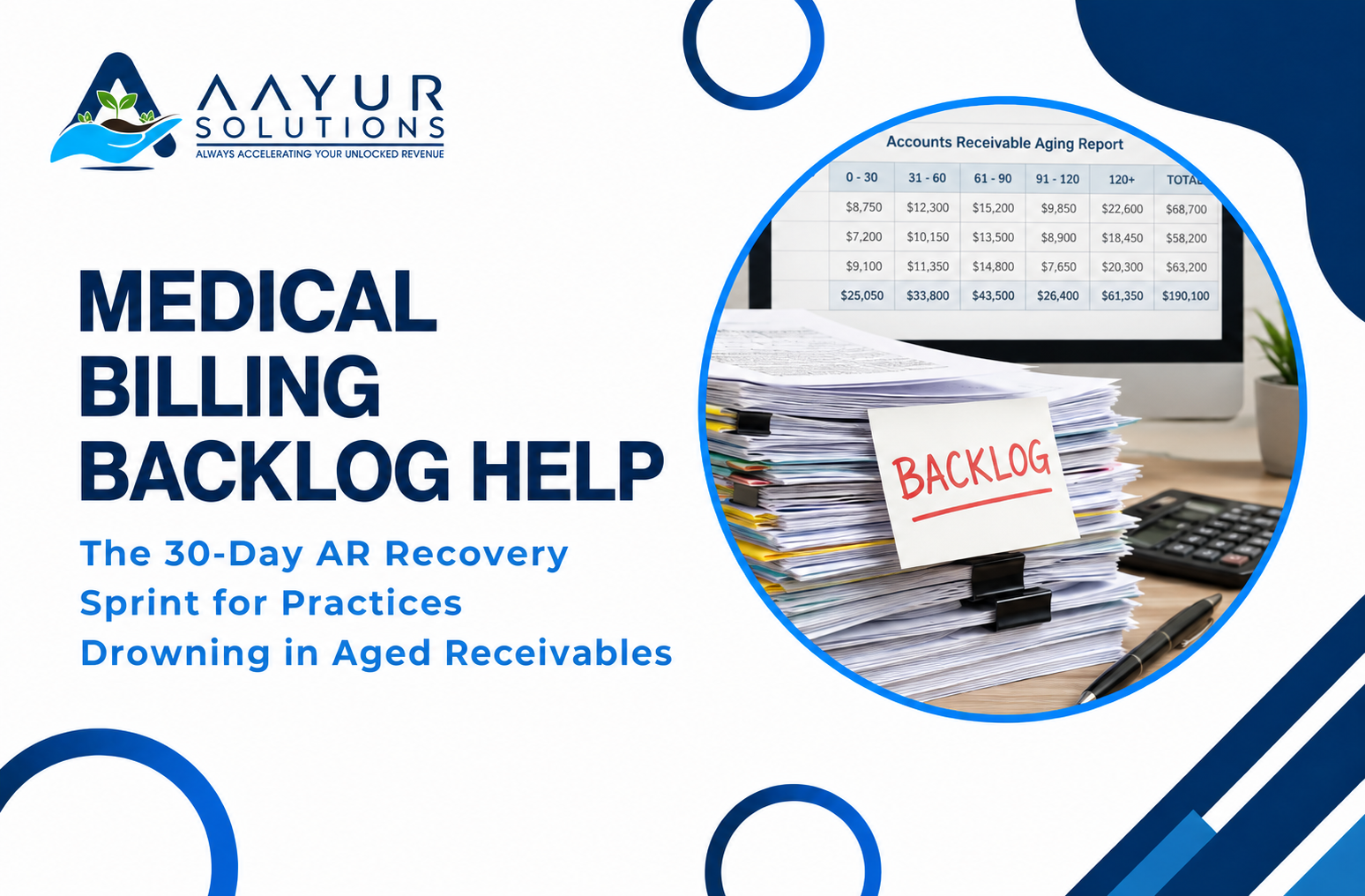
If your AR aging report shows more than 20% of receivables sitting beyond 90 days, you do not have a workload problem. You have a structural problem — and adding more follow-up calls to broken claims will not fix it.
Medical billing backlog help looks different from practice to practice. Some need a rapid-response team deployed overnight. Some need someone to finally map why the same denial codes keep repeating. Most need both. The 30-Day AR Recovery Sprint is how Aayur Solutions approaches it: triage first, specialist deployment within 48 hours, structured recovery execution, and a prevention system handed back to your team on Day 30 so the backlog never returns.
This guide walks through exactly how that works — and how to know whether your practice needs it now or in the next 30 days.
The Real Reason AR Ages Past 90 Days
Clean claims do not age to 120 days. Only broken ones do.
When AR over 90 days exceeds 15–20% of your total receivables, it is almost never a volume problem. It is a front-end failure — wrong eligibility verification, expired authorizations, documentation gaps, or denial patterns that never get fed back to the intake team — that looks like a back-end problem because it shows up in the aging report.
| Symptom | What It Actually Means | Why More Follow-Up Fails |
|---|---|---|
| AR >90 days exceeds 20% | Front-end failures masquerading as a collection problem | Reworking claims with missing auths = 0% recovery |
| Same denial codes repeating | No root-cause feedback loop from denials back to intake | 17% of denied claims are never appealed at all |
| Staff turnover creates billing gaps | Tribal knowledge leaves with the biller | New hires take 60–90 days to ramp; backlog grows faster |
| Provider documentation always incomplete | No structured protocol for medical necessity requirements | Claims without documentation do not get paid regardless of clinical validity |
The moment you understand that aged AR is a symptom — not the disease — the right response becomes clear: triage the root cause, stratify what is actually recoverable, and deploy the right specialist type against the right bucket.
What the 30-Day AR Recovery Sprint Actually Is
Most AR recovery services send a generalist team to work every aging bucket in order. The sprint does the opposite: it starts by determining which claims are worth working at all.
| Traditional AR Recovery | Aayur’s 30-Day AR Recovery Sprint |
|---|---|
| Generic follow-up on all aging buckets | Triage-first: only work claims with a realistic recovery path |
| No feedback to front-end operations | Root-cause tagging: every denial maps back to intake, auth, coding, or chart |
| 90–180 day vendor engagements | 30-day sprint with weekly go/no-go decisions |
| Generalist billers across all specialties | Bench specialists deployed by specialty within 48 hours |
| Recovery only — no prevention | Prevention system delivered as sprint output on Day 30 |
The sprint is not a longer version of what you are already doing. It is a different methodology entirely — one where the output is not just recovered dollars but a documented system your team can run independently.
The 4-Phase Sprint Methodology
Phase 1 — Days 1 to 3: Triage and Stratification
Before a single claim gets worked, every AR dollar gets classified. We pull a complete AR aging export and stratify every claim into one of four buckets:
- Priority 1 — Emergency: AR over 180 days with high dollar value, timely filing windows closing within 30 days, or clearly recoverable denials. These get worked first, on Day 1.
- Priority 2 — Core Recovery: AR 90–180 days with a clear recovery path — expired auths that can be retro-appealed, eligibility mismatches corrected, coding errors with supporting documentation.
- Priority 3 — Complex Cases: AR 60–90 days requiring provider input, multi-payer coordination, or medical necessity documentation.
- Priority 4 — Write-Off Candidates: Claims beyond 365 days with no documentation or a cost-to-recover exceeding expected reimbursement. Flagged for your approval — we never write off without your sign-off.
Deliverables by Day 3:
- Stratified AR workbook with every claim bucketed and a recovery probability percentage
- Root-cause heatmap showing which denial codes trace back to which front-end failure point
- Resource allocation plan detailing which specialist types are needed for each bucket
- Weekly dollar-based recovery targets — not claim-count targets
Phase 2 — Days 4 to 15: Core Recovery Execution
Once triage is complete, bench specialists are deployed against Priority 1 and 2 claims within 48 hours of engagement. Specialists are matched by payer type and specialty — a DME authorization denial gets a DME specialist, not a generalist biller. Every worked claim gets a root-cause tag that feeds the prevention system built in Phase 4.
| Time | Activity |
|---|---|
| Morning | Daily huddle: overnight payer responses, blockers, escalations |
| Morning block | Deep work on Priority 1 and 2 claims — no meetings, no interruptions |
| Midday | Blocker review: claims needing provider documentation or auth corrections |
| Afternoon block | Appeal writing, resubmission, peer-to-peer coordination, medical necessity letters |
| End of day | Recovery summary: dollars worked, dollars posted, next-day priorities |
Phase 3 — Days 16 to 25: Complex Resolution and Provider Collaboration
Most AR stalls in this range because getting anything done requires provider time — progress notes, face-to-face documentation, signed orders, or peer-to-peer availability. This is where backlogs go to die if there is no structured protocol.
- Chart Review Sprint (Days 16–18): We pull the 20 highest-value stuck claims and identify the exact missing documentation for each. The provider receives one checklist — not an inbox of individual requests.
- Daily Blockers Standup (Days 19–22): 15 minutes, blockers only. No status updates, no reports, no lengthy discussions.
- Final Resolution (Days 23–25): Final appeals filed, peer-to-peer appointments scheduled, write-off approvals collected.
Phase 4 — Days 26 to 30: Prevention System Delivery
This is the phase most AR recovery services skip entirely — and the reason practices end up calling for the same help six months later. The sprint output is a functioning prevention system, not just a recovery report.
| Deliverable | What It Does |
|---|---|
| AR Health Scorecard | Weekly visibility into aging buckets, denial trends, and recovery rate |
| Denial Root-Cause Taxonomy | Every denial code mapped to the specific front-end failure point that caused it |
| Front-End Fix Checklist | Exactly what intake must capture to prevent each top-10 denial code — one page per specialty |
| Prior Authorization Tracking Template | Auth status, expiration dates, renewal workflow in a shared tracker your team controls |
| Provider Documentation Cheat Sheets | Exact language and templates for medical necessity letters and face-to-face documentation |
| Weekly AR Review Agenda | A 30-minute structured meeting template: metrics, blockers, decisions — nothing else |
| Escalation Matrix | Who acts on which denial type, at which aging bucket, and by when |
When the sprint ends, your team has the tools to prevent the next backlog from forming.
How to Know If You Need the Sprint Now
Red Flags — Start the Sprint Immediately
- AR over 90 days exceeds 20% of total receivables
- AR over 120 days exceeds 10% of total receivables
- Timely filing denials have appeared in the last 30 days
- A key biller or AR lead has resigned or gone on leave
- You are mid-EHR transition and claims are falling through the cracks
- An audit or RAC review is coming and the AR needs to be cleaned up first
- Cash flow is at risk
Yellow Flags — Schedule the Sprint Within 30 Days
- AR over 90 days is between 15–20% and trending upward month over month
- The same top five denial codes are repeating for three or more consecutive months
- No prior authorization tracking system is in place
- Providers are receiving complaints about delayed payments
- A seasonal volume spike is coming and current capacity cannot absorb it
Green — You Are in Good Shape (Monitor Monthly)
- AR over 90 days is under 10% consistently
- Clean claim rate exceeds 95%
- Denial rate is under 5% with active root-cause tracking
- Each specialty has a dedicated AR specialist
What Recovery Rates Are Realistic?
Practices often hear inflated promises on AR recovery. Here is what is actually achievable based on claim age and documentation status:
| AR Age Bucket | Realistic Recovery Range | Key Factor |
|---|---|---|
| 90–180 days (with documentation) | 60–80% | Auth/eligibility fixable via appeal or retro-auth |
| 90–180 days (missing docs) | 30–50% | Provider collaboration required |
| 180–365 days | 35–50% | Timely filing risk; payer-specific |
| Over 365 days | Under 10% | Majority recommended for write-off review |
Every sprint starts with stratification so you know the recovery ceiling before any work begins — not after the invoice arrives.
Frequently Asked Questions About Medical Billing Backlog Help
How fast can you start working our AR?
Bench specialists are deployed within 48 hours of a signed agreement. Onboarding requires EHR read access, an AR aging export, and a 30-minute kickoff call. Specialists hit claims on Day 1.
Our AR is a complete mess — missing documentation, no auth tracking, incomplete provider notes. Can you still help?
That is exactly the situation the sprint is designed for. The process includes rebuilding auth tracking from scratch, creating provider documentation templates, and identifying which claims are salvageable before spending time on ones that are not. The sprint output fixes the mess — not just the symptoms.
Do we need to change our EHR or give full system access?
No EHR change required. The sprint operates via a secure AR aging export, limited claim-level portal access, and a shared tracker your team already has access to. Zero disruption to your current operations.
What recovery rate can we realistically expect on AR over 120 days?
AR aged 90–180 days with documentation typically sees 60–80% recovery. AR aged 180–365 days typically sees 35–50%. Claims over 365 days with no supporting documentation are generally recommended for write-off review. Every sprint starts with stratification so you know the ceiling before work begins.
What happens after Day 30 — are we on our own?
Three options: transition to a managed AR engagement, a full internal handoff with 30 days of support included, or quarterly booster sprints where the team returns for one week every quarter. There is no cliff edge at Day 30.
Flexible Engagement — Built Around Your Practice
The sprint is structured around your situation, not a one-size-fits-all contract. Flexible pricing options are available based on practice size, AR volume, and whether you prefer a recovery-based or capacity-based model. Every engagement starts with a free 30-minute triage call where we pull your aging data, stratify what is actually recoverable, and tell you exactly what the sprint would target — before you commit to anything.
Ready to Stop the Bleeding?
Whether you are in crisis today or want to prevent one, the first step is a 30-minute triage call where we look at your actual AR aging report and tell you what is recoverable, what is not, and what the sprint would target.
No obligation. No contract required for the triage.
Or call directly: (307) 219-1936
The 30-Day AR Recovery Sprint is available across every specialty Aayur works with — from DME suppliers and dental practices to pain management clinics and behavioral health providers. See the full list of specialties we serve to confirm your practice type is covered.

Written by
Ajay Pillai CEO & Founder, Aayur Solutions LLCAjay Pillai is the CEO of Aayur Solutions with 17+ years in U.S. healthcare revenue cycle management across DME/HME, dental, pain management and specialty billing.
Connect on LinkedIn