
On July 14, 2026, CMS dropped a proposal inside the CY 2027 Physician Fee Schedule that didn’t make many headlines — but it should have.
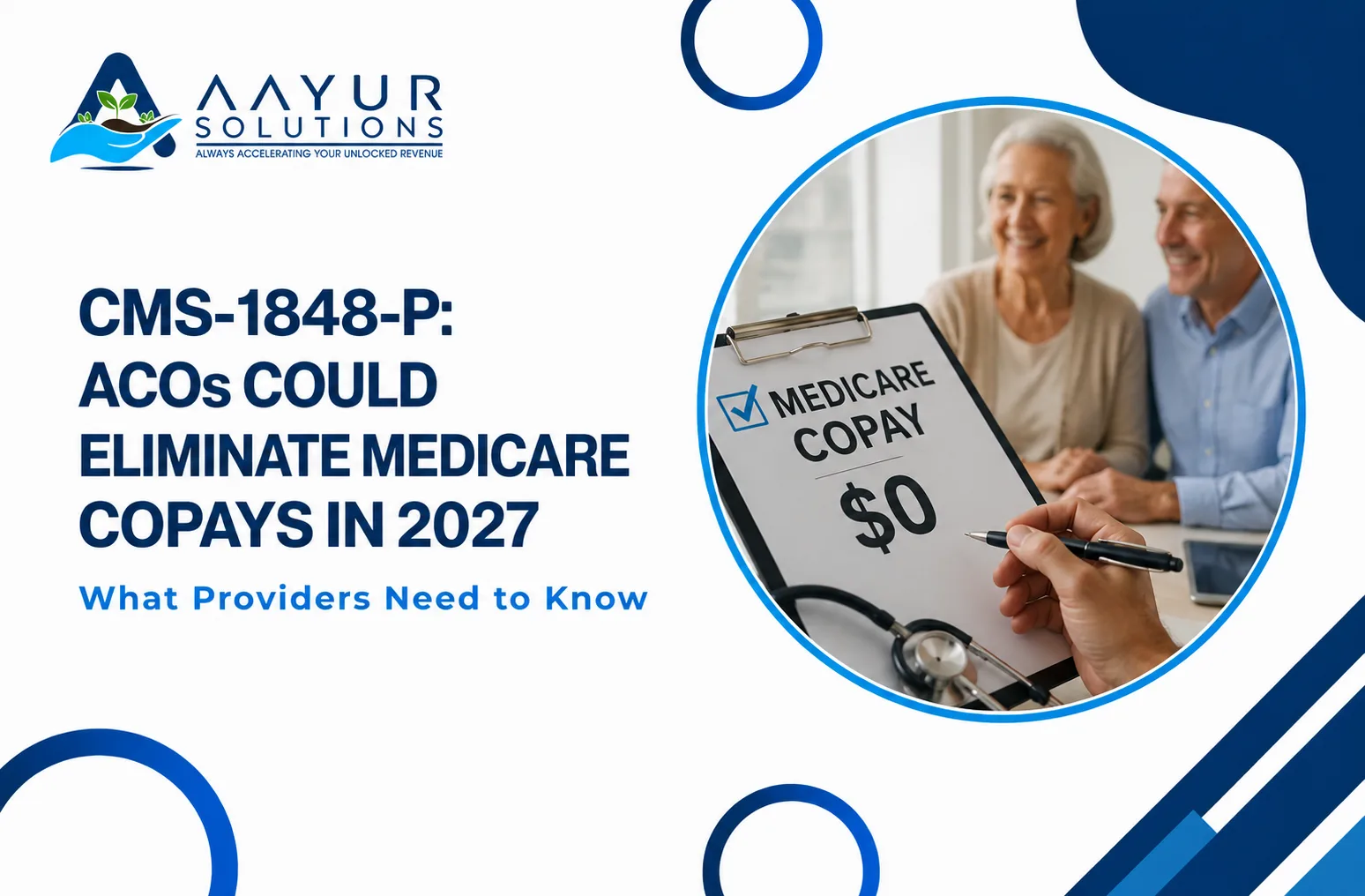
Buried in the Medicare Shared Savings Program section of the proposed rule (CMS-1848-P) is a provision that could fundamentally change how Medicare patients choose their doctors: CMS is proposing to let ACOs reduce or eliminate Part B cost-sharing for assigned beneficiaries.
Translated from Washington-speak: if your practice participates in a Medicare Shared Savings Program ACO, you could soon tell your Medicare patients, “Your copay is zero. You pay nothing for this visit.”
If your practice is NOT in an ACO, your competitor down the street who IS in one could make that same offer — and you can’t.
That’s not a reimbursement tweak. That’s a competitive weapon.
What CMS Actually Proposed in the 2027 Medicare Shared Savings Program Changes
The proposed rule would allow eligible ACOs to enter “Part B cost-sharing support arrangements” with their ACO participants. Under this arrangement, an ACO could reduce or eliminate beneficiary cost-sharing for:
- All Original Medicare Part B items and services
- For eligible beneficiaries identified by the ACO
With two notable exceptions: durable medical equipment, prosthetics, orthotics, and supplies (DMEPOS) and prescription drugs are carved out. Everything else — office visits, procedures, diagnostic tests, therapy services — is fair game.
The timeline is aggressive. CMS anticipates collecting initial applications in early 2027, with approved ACOs offering reduced or eliminated cost-sharing by the second quarter of 2027 — roughly nine months from now.
The proposal didn’t come out of nowhere. CMS explicitly states it was “informed by experience in the ACO REACH model,” the CMS Innovation Center’s flagship accountable care program. CMS tested this in a smaller program, liked what it saw, and is now proposing to scale it to the main Shared Savings Program — the largest accountable care program in Medicare, covering millions of beneficiaries across roughly 480 ACOs.
Why This Is Different From Everything That Came Before
Medicare has never allowed this. Not in its 60-year history.
The Medicare program has always required beneficiary cost-sharing — the 20% coinsurance for Part B services — as a fundamental feature of the program’s design. The theory was that cost-sharing discourages overutilization: patients with skin in the game make more cost-conscious decisions.
CMS is now signaling that it believes the ACO model’s built-in financial accountability — the fact that ACOs are on the hook for total cost of care — sufficiently replaces the need for beneficiary cost-sharing as a utilization brake. If the ACO is financially responsible for total spending, the argument goes, the ACO has every incentive to prevent unnecessary utilization without needing the patient’s 20% as a deterrent.
This is a philosophical shift, not just a payment policy change.
The Competitive Math
Let’s make this concrete with real numbers.
A Medicare patient who has already met the Part B deductible sees a cardiologist for an established patient visit (CPT 99214). Under the proposed CY 2027 non-qualifying APM conversion factor of $32.84, that visit reimburses roughly $110. The patient owes approximately $22 in coinsurance.
Now multiply that across a typical Medicare panel. A primary care practice with 500 Medicare patients averaging 4 visits per year, with average coinsurance of $20 per visit, is collecting roughly $40,000 per year in Medicare patient copays.
For higher-acuity specialties, the patient cost-sharing amounts are substantially larger — a stress echo with a $300 allowed amount means $60 out of the patient’s pocket.
Now imagine your practice — the ACO participant — telling those patients: “You owe nothing. Zero.”
What do you think happens to the non-ACO practice across town?
Patients won’t switch doctors solely over a $20 copay. But when a fixed-income Medicare beneficiary is choosing between two otherwise comparable specialists — and one says “no charge today” while the other sends a bill — the decision gets easier.
The DMEPOS Exclusion: The Part Nobody Is Talking About
Here’s the angle most coverage has missed entirely: DME is carved out.
If you’re a DME/HME supplier, your patients will keep paying their 20% on every walker, CPAP, and wheelchair — while the office visit that prescribed it, the therapy that follows it, and nearly every other Part B service around it could go copay-free. From the patient’s chair, that contrast will be jarring: “Everything else was free — why am I getting a bill from the equipment company?”
That means three things for DME suppliers between now and 2027:
- Patient collections get harder, not easier. When cost-sharing disappears everywhere else, the DME bill becomes the most visible out-of-pocket expense in the patient’s care journey — expect more billing questions, more disputes, and more bad-debt risk on the patient-responsibility portion.
- Point-of-delivery collection discipline becomes critical. Collecting the 20% upfront, with clean DME billing workflows for eligibility and prior authorization, will separate suppliers who protect margins from those who chase balances.
- The exclusion is worth a comment letter. DMEPOS suppliers and their associations have until September 14, 2026 to tell CMS what this carve-out does to equipment adherence — a documented barrier for exactly the chronic-care patients ACOs are trying to help.
What This Means for Different Practice Types
Independent Practices
If you’re an independent practice not currently in an ACO, this proposal should make you reconsider. The combination of this cost-sharing flexibility PLUS the proposed 32% E/M complexity modifier (MOD2) for ACO participants means the financial case for ACO participation just got materially stronger.
But joining an ACO is not a trivial decision. You’re accepting shared financial risk, committing to quality reporting, and ceding some autonomy in care delivery decisions.
The question becomes: does the competitive advantage of zero-copay Medicare offset the operational burden and financial risk of ACO participation? For many independent primary care practices serving high-Medicare populations, the answer is increasingly yes. For specialty practices that rely on referrals from ACO primary care providers, you may not have a choice — if your referring physicians are all in ACOs offering zero cost-sharing, you may need to align with those ACOs to maintain referral volume.
Specialty Clinics — Including Pain Management
The proposal creates an interesting dynamic for specialists. Specialists inside ACOs can offer reduced cost-sharing to referred patients — and because specialty services carry higher allowed amounts, the “zero copay” offer is proportionally more meaningful.
Interventional pain management is a prime example. Epidural steroid injections, facet procedures, and radiofrequency ablation are all Part B services carrying 20% coinsurance — often $100+ per procedure, and multi-injection series can leave patients owing several hundred dollars across an episode of care. An ACO-affiliated pain practice that can waive that cost-sharing removes the single biggest financial objection to completing a treatment plan. For the practices themselves, that shifts the revenue-cycle burden from chasing patient balances to airtight pain management billing on the payer side — prior auth, diagnostic-block sequencing, and unit limits — because the payer-paid portion becomes essentially all of the revenue.
Consider also gastroenterology: patient cost-sharing for a diagnostic colonoscopy after a positive FIT test can be $200 or more. An ACO-affiliated GI practice that waives it has a meaningful patient-acquisition advantage.
But here’s the catch: the cost-sharing reduction is absorbed by the ACO, not paid by CMS. The ACO’s economics need to support covering patient copays — and for high-cost specialty services, that math gets challenging fast.
Hospital-Owned Groups
For hospital-owned medical groups already in ACOs, this is likely net positive but operationally complex. Most already run financial assistance and charity care programs; layering ACO cost-sharing reduction on top requires careful coordination to avoid compliance issues. The larger opportunity may be using cost-sharing reduction as a population health tool — targeting high-risk patients for whom cost-sharing is a documented barrier to adherence and follow-up care.
The Operational Reality: What Practices Must Do Now
1. Determine your ACO status. Already a participant? Start conversations with your ACO leadership about their intent to apply. Not in one? Evaluate whether this changes your calculus.
2. Run the financial model. Calculate your current Medicare patient cost-sharing revenue and model what happens if it’s eliminated — who absorbs the cost, how it’s funded, and the net impact including potential volume gains.
3. Assess your patient population. Which Medicare patients would benefit most? Which services have the highest cost-sharing burden relative to clinical value?
4. Prepare your revenue cycle. If your ACO gets approved, your billing workflow changes: identifying claims subject to the reduction, applying it correctly at point of service, and tracking the financial impact separately. Your revenue cycle management partner should be involved in this planning now, not after the policy takes effect.
5. Engage with CMS. The comment period closes September 14, 2026 (regulations.gov, file code CMS-1848-P).
6. Watch the final rule. Expected in November. Don’t make irreversible decisions on a proposed rule — but don’t wait until November to start planning either.
Common Mistakes Practices Make With CMS Proposals
After 17+ years helping practices navigate CMS rulemaking cycles, here are the mistakes we see repeatedly:
Mistake #1: Assuming the proposal won’t be finalized. CMS doesn’t publish proposals it isn’t serious about — and this one was already tested in ACO REACH.
Mistake #2: Waiting until the final rule to start planning. The ACOs applying in early 2027 are the ones preparing now.
Mistake #3: Viewing this as just a billing issue. It affects patient acquisition, competitive positioning, and practice valuation.
Mistake #4: Underestimating operational complexity. Zero-copay programs create cascading questions — eligibility verification, out-of-network scenarios, mid-treatment status changes.
Mistake #5: Not talking to your RCM partner. They build the workflows, configure the system logic, and train the staff. If they don’t understand the policy, your implementation fails.
Frequently Asked Questions
Does CMS pay the cost-sharing that ACOs eliminate?
No. The ACO absorbs the cost — the proposal is structured as a “cost-sharing support arrangement” between the ACO and its participants, typically sustained by the ACO’s shared savings performance. CMS does not reimburse the waived amounts.
Can individual practices eliminate Medicare cost-sharing on their own?
No. This authority is only available through a CMS-approved ACO. Practices cannot unilaterally waive Medicare cost-sharing.
Does this apply to Medicare Advantage patients?
No. It applies to Original Medicare beneficiaries assigned to a Shared Savings Program ACO.
What about patients with Medigap?
Medigap typically covers the 20% coinsurance already, so the direct financial impact is smaller — though the behavioral effect of “nothing owed” may still matter.
What services are excluded from ACO cost-sharing elimination?
Durable medical equipment, prosthetics, orthotics, and supplies (DMEPOS), and prescription drugs. Everything else in Part B is eligible under an approved plan.
Can ACOs waive copays for some services but not others?
Yes — the rule allows ACOs to target “certain categories of Part B items and services and eligible beneficiaries,” so selective application is permitted.
How does the prepaid shared savings option interact with this?
CMS is proposing to remove the prepaid shared savings option due to low uptake, positioning cost-sharing elimination as the replacement path. Existing participants receive payments through December 31, 2027.
When does this actually start?
If finalized: applications in early 2027, with the first ACOs reducing cost-sharing by Q2 2027 (April–June).
Key Takeaways
- This is real — proposed in CMS-1848-P, tested in ACO REACH, targeted for Q2 2027.
- It creates competitive asymmetry — ACO practices could offer zero-copay Medicare; non-ACO practices can’t.
- DME is excluded — DMEPOS suppliers keep billing patients 20% while surrounding services go copay-free, making patient collections discipline more important than ever.
- Specialists are in play — high-coinsurance specialties like interventional pain see the largest per-patient impact.
- The window is now — comments due September 14, final rule in November, applications early 2027.
- Your RCM infrastructure must be ready — patient statements, collections workflows, eligibility verification, and reporting all change.
Disclaimer: This article discusses a CMS proposed rule (CMS-1848-P) published July 14, 2026. Proposed rules are not final and may change before implementation. This analysis is professional interpretation and not legal or financial advice.