
If you are asking what it costs to outsource medical billing, the short answer is: most billing companies charge 3–9% of monthly collections, with the average practice paying 4–7%. But that single number hides everything that actually matters — what is included, what is billed separately, and whether outsourcing costs less than what you are spending right now on in-house billing.
This guide breaks down every pricing model, gives you real cost comparisons against in-house billing, and shows you the hidden fees to catch before signing any contract.
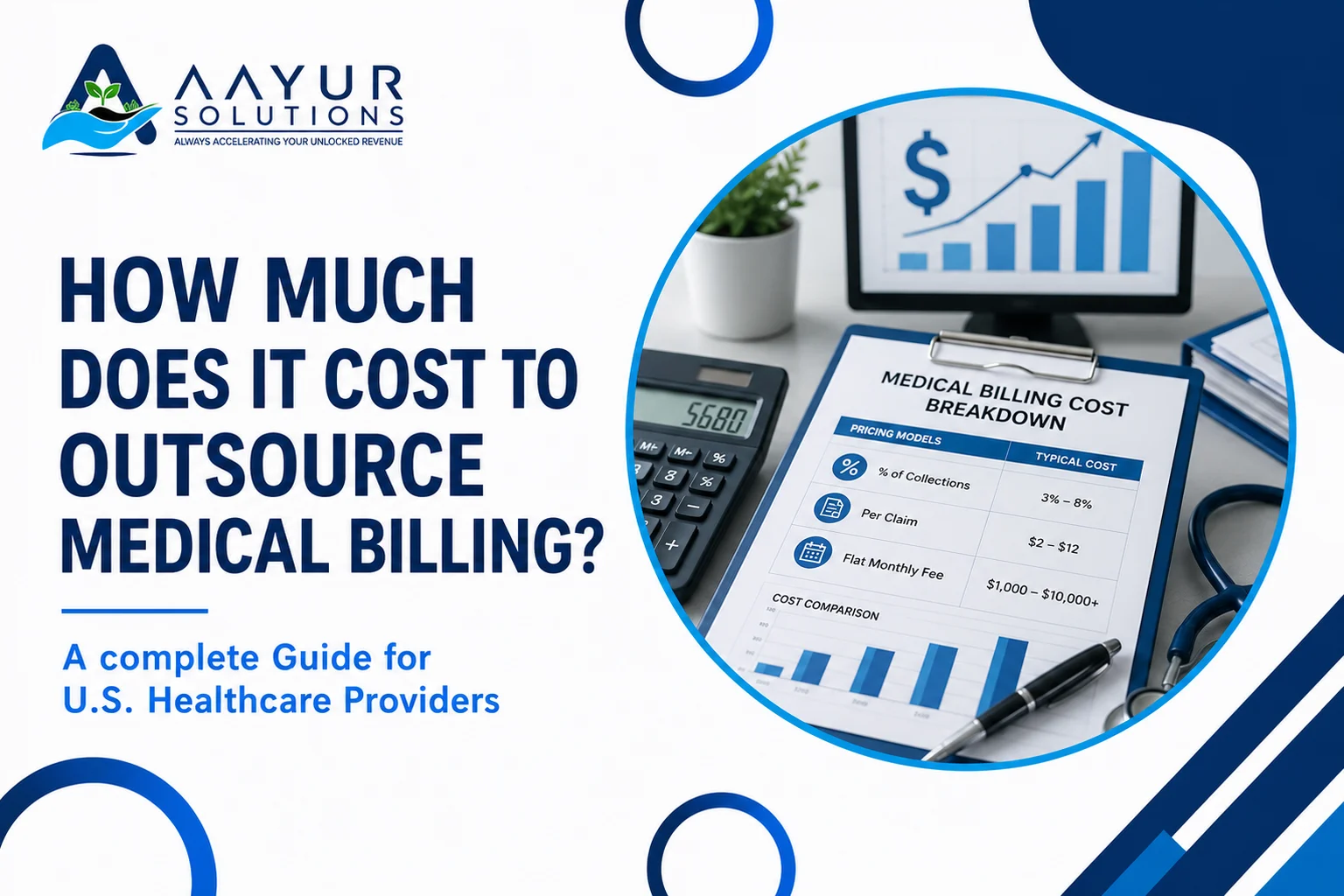
The 4 Medical Billing Pricing Models Explained
1. Percentage of Collections (Most Common)
The billing company takes a percentage of what they actually collect for you — not what they bill. If they collect $100,000 in a month at a 5% rate, you pay $5,000.
Typical rates in 2026:
| Practice type | Typical rate |
|---|---|
| Primary care / family medicine | 4–7% |
| Specialty practices (cardiology, ortho) | 5–8% |
| Pain management | 5–8% |
| DME / HME suppliers | 5–9% |
| Dental billing | 4–7% |
| Behavioral health | 6–9% |
| High-volume hospital groups | 3–5% |
Why percentage pricing dominates: the billing company only gets paid when you get paid. Their incentive is aligned with yours — collect more, faster.
Watch for: whether the percentage is charged on collections (correct) or on billed charges (a red flag — you would pay for claims that were never reimbursed).
2. Flat Fee Per Claim
You pay a fixed amount for every claim submitted — typically $3 to $10 per claim depending on specialty complexity.
Best for: high-volume, low-complexity practices where claims are routine and denial rates are already low.
The trap: per-claim pricing pays the biller for submission, not collection. A company earning $5 per claim earns it whether the claim is paid or denied. Follow-up and appeals are often billed separately.
3. Flat Monthly Rate
A fixed monthly retainer — usually $1,000 to $6,000+ per month depending on practice size and scope.
Best for: practices that want predictable budgeting, and small practices whose collection volume makes percentage pricing awkward for the vendor.
Watch for: scope creep clauses. What happens when your claim volume grows 30%? Get the volume thresholds in writing.
4. Hybrid Models
A smaller base fee plus a reduced percentage (for example, $500/month + 3% of collections). Increasingly common for practices in growth mode.
In-House vs Outsourced: The Real Cost Comparison
Most practices dramatically underestimate what in-house billing actually costs, because the spend is scattered across salary, software, and lost revenue lines.
True cost of one in-house biller (2026):
| Cost item | Annual cost |
|---|---|
| Biller salary (median) | $48,000–$58,000 |
| Payroll taxes + benefits (~25%) | $12,000–$14,500 |
| Practice management / billing software | $6,000–$15,000 |
| Clearinghouse fees | $1,200–$3,600 |
| Training, certifications, coding updates | $1,500–$3,000 |
| Coverage gaps (vacation, sick leave, turnover) | Variable — often the biggest hidden cost |
| Total | $68,000–$94,000+ |
Same practice outsourced (example: $1.2M annual collections at 5%): $60,000/year — with no software costs, no turnover risk, no coverage gaps, and a team instead of one person.
But the bigger number is not the fee — it is the collection rate. In-house billers juggling front-desk duties typically achieve 60–70% first-pass clean claim rates. Professional billing companies routinely deliver 95%+. On $1.2M of billed charges, a 10-point improvement in net collections is worth $120,000 — twice the entire outsourcing fee.
What Should Be Included in the Price (Checklist)
Before comparing quotes, confirm each vendor includes all of the following in their base rate:
- Claim scrubbing and submission
- Payment posting (ERA and manual)
- Denial management and appeals — not just resubmission
- AR follow-up on unpaid claims (30/60/90+ days)
- Patient statement processing
- Eligibility and benefits verification
- Prior authorization support
- Monthly reporting (collections, denial rate, AR days, net collection rate)
- Dedicated account manager
If any of these appear as “add-ons,” your real rate is higher than the quoted rate.
7 Hidden Fees to Catch Before You Sign
- Setup / implementation fees — $500–$5,000. Negotiable, often waivable.
- Patient statement fees — $0.50–$1.50 per statement, adds up fast.
- Termination clauses — 90-day notice periods and “AR ransom” clauses that charge you to get your own data back.
- Credentialing charged separately — $100–$300 per payer per provider.
- Old AR exclusions — many companies won’t work your existing aged AR, or charge 10–15% on recovered old claims.
- Software licensing passed through — confirm who pays for the PM system.
- Minimum monthly fees — a “4% rate” with a $3,000 minimum is not 4% for a small practice.
Is Outsourcing Worth It for a Small Practice?
For practices collecting under $50,000/month, this is usually where outsourcing makes the most sense, not the least. A solo or small practice cannot justify a full-time certified biller plus software — but at 5–7% of collections, a $40,000/month practice pays $2,000–$2,800 for a full billing department.
The break-even question is simple: is your current net collection rate above 95%? If not, a billing partner typically pays for itself before you count a single hour of staff time saved.
Questions to Ask Every Billing Company Before Signing
- Is your fee on collections or billed charges?
- What is your average first-pass clean claim rate?
- Who handles denials and appeals — and is it included?
- What is your average client’s net collection rate and AR days?
- Do I keep ownership of my data if we part ways?
- Are there setup fees, minimums, or statement fees?
- Do you have experience in my specialty?
Frequently Asked Questions
How much does it cost to outsource medical billing?
Most U.S. billing companies charge 3–9% of monthly collections, with 4–7% being typical. Alternatives include per-claim pricing ($3–$10/claim) and flat monthly retainers ($1,000–$6,000+).
Is it cheaper to outsource medical billing or keep it in-house?
For most small and mid-size practices, outsourcing costs less than the fully loaded cost of in-house billing staff, software, and clearinghouse fees — and usually improves collections at the same time.
What percentage do medical billing companies charge?
The industry standard is 4–7% of collected revenue. Complex specialties like DME, behavioral health, and pain management trend toward the higher end due to prior authorization and documentation workload.
Are there any upfront costs to outsource billing?
Some companies charge setup fees of $500–$5,000, though many waive them. Always ask about implementation costs, credentialing fees, and monthly minimums before signing.
How do I know if a billing company is performing?
Track four numbers monthly: net collection rate (target 96%+), first-pass clean claim rate (target 95%+), denial rate (target under 5%), and days in AR (target under 35).
Get a Transparent Medical Billing Quote
Aayur Solutions provides end-to-end medical billing and revenue cycle management with straightforward percentage-of-collections pricing — no setup fees, no statement fees, no minimums, and no long-term lock-in. Claim submission, denial management, AR recovery, prior authorization, and monthly performance reporting are all included in one rate.
Request a free billing cost analysis from Aayur Solutions →
Still weighing your options? Read our full comparison: In-House vs Outsourced Billing: What Most Practices Get Wrong.