
If your practice is losing revenue, waiting weeks for approvals, and watching claim after claim come back denied — prior authorization is almost certainly at the center of it.
Prior authorization in medical billing is the single most time-consuming administrative task healthcare providers face today. It delays patient care, overwhelms billing staff, and quietly drains revenue from practices that never see the problem clearly until it is too late.
This guide covers everything your team needs to know: what prior authorization means, how the process works step by step, the most common denial reasons, and exactly how leading practices are reducing prior auth failures in 2026.
What Is Prior Authorization in Medical Billing?
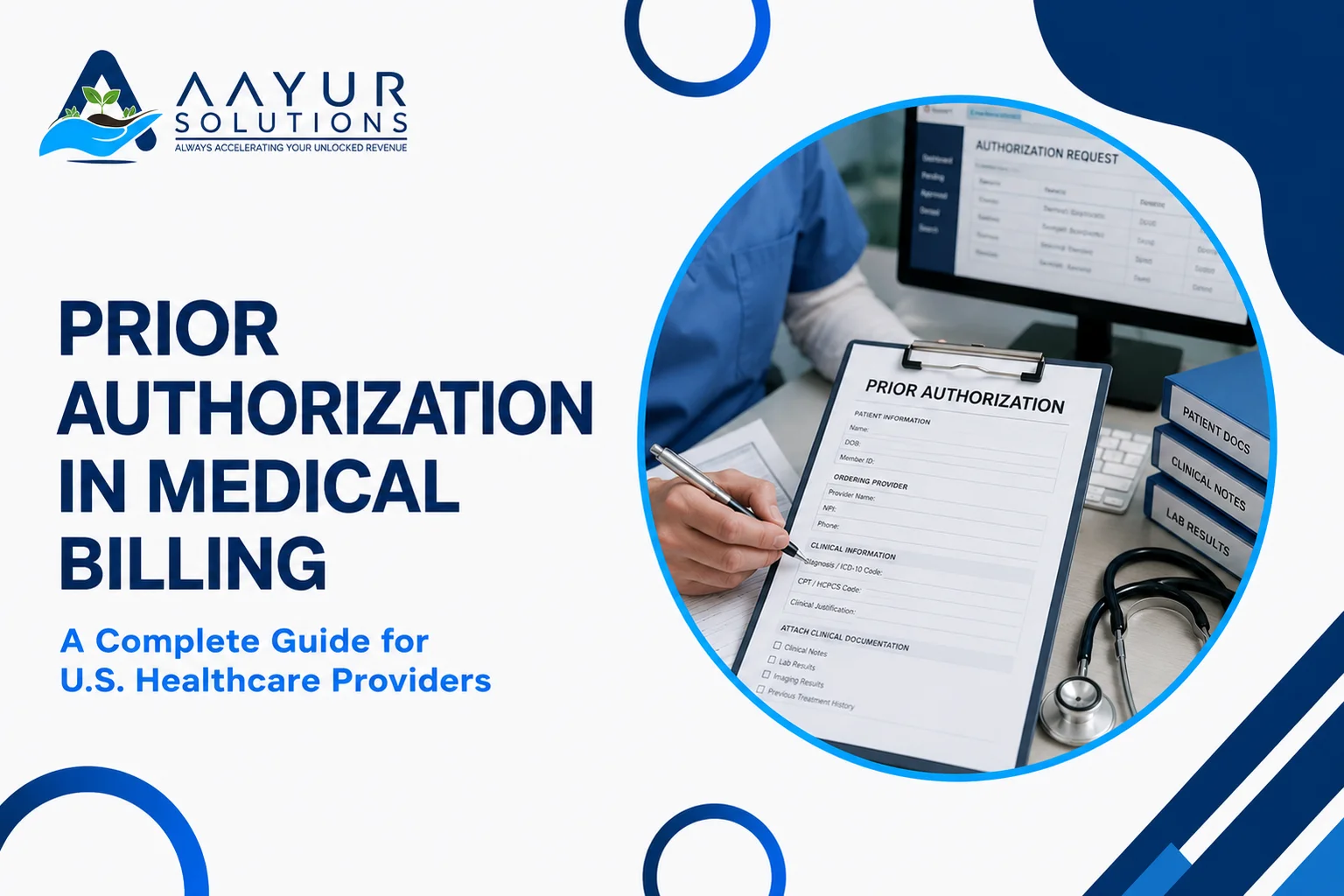
Prior authorization (also called pre-authorization, pre-approval, or prior approval) is a requirement from a patient’s insurance company that a provider must get approval before delivering a specific service, procedure, medication, or referral. Without that approval, the insurer can legally deny the claim — even if the service was medically necessary and already delivered.
In medical billing, prior authorization sits between the point of scheduling and the point of claim submission. It is not optional. If the payer requires it and you skip it, you will not get paid.
Common services that almost always require prior authorization:
- MRI, CT scans, and PET scans
- Elective surgeries and outpatient procedures
- Specialty medications and biologics
- Durable medical equipment (DME) and home health equipment (HME)
- Physical therapy beyond a set number of visits
- Behavioral health and substance use treatment
- Pain management procedures (nerve blocks, spinal injections)
- Home health and infusion therapy
Prior authorization is not the same as a referral. A referral is a physician directing a patient to a specialist. Prior authorization is the insurer’s formal sign-off that they will cover a specific item or procedure.
Why Prior Authorization Is Quietly Draining Your Practice Revenue
The American Medical Association’s 2024 survey found that physicians and their staff spend an average of 13 hours per week on prior authorization tasks. For a small or mid-size practice, that is nearly one full-time employee’s week — every single week — spent on paperwork instead of patient care.
Here is what that costs you in real numbers:
- 25–30% of all claim denials are linked directly to prior authorization failures — either missing auth, expired auth, or auth obtained for the wrong service code
- The average cost to rework a denied claim is $25–$118 depending on complexity
- 17% of prior auth denials are never appealed — that is money written off that practices had every right to collect
- Practices that outsource prior authorization recover an average of 8–12% more net revenue in the first 6 months
The deeper problem is that most practices do not track prior auth denial rates separately from overall denial rates. If you are not measuring it, you cannot fix it.
How Prior Authorization Works — Step by Step
Understanding the full workflow helps your team catch failures before they become denials.
Step 1: Verify Whether Authorization Is Required
Before scheduling, your front desk or billing team checks the patient’s insurance plan to confirm whether the service requires prior auth. This verification should happen at scheduling — not the day before the appointment.
Every payer has a different list of services requiring authorization. United Healthcare, Aetna, Cigna, and Humana all have different rules, and those rules change regularly. A service that did not require auth last year may require it now.
Step 2: Gather Clinical Documentation
The payer will ask for clinical justification. This typically includes:
- The physician’s notes documenting medical necessity
- Relevant diagnosis codes (ICD-10)
- Prior treatment history showing the requested service is appropriate
- Lab results, imaging reports, or specialist notes if applicable
Incomplete documentation is the #1 reason prior auth requests are initially rejected.
Step 3: Submit the Authorization Request
Requests are submitted via the payer’s online portal, fax, or electronic data interchange (EDI), depending on the insurer. Most large payers now have provider portals, but smaller regional plans still rely on fax.
Key information your submission must include:
- Patient name, date of birth, and member ID
- Provider NPI and group NPI
- Procedure code (CPT) and diagnosis code (ICD-10)
- Place of service code
- Requested dates of service
- Clinical documentation supporting medical necessity
Step 4: Track the Request and Follow Up
This is where most practices lose control. Payers have 3–14 business days to respond depending on state law and the urgency of the request. Urgent requests must receive a response within 72 hours under most state regulations.
If your team does not have a tracking system, authorization requests get lost. The appointment passes, the service is delivered, and the claim goes out without auth — straight to denial.
Step 5: Receive and Document the Authorization
When approved, the insurer provides an authorization number and an approved service window (specific CPT codes, number of visits, and date range). This authorization number must be recorded in the patient record and attached to every claim you submit for that service.
Authorization errors that cause denials even after approval:
- Service delivered outside the authorized date range
- CPT code on the claim does not match the authorized CPT code
- Number of units billed exceeds the authorized quantity
- Wrong facility or location used
Step 6: Submit the Claim With the Auth Number
The authorization number goes in Box 23 of the CMS-1500 claim form (or the equivalent field in electronic 837P submissions). If it is missing or incorrect, expect a denial.
The 7 Most Common Prior Authorization Denial Reasons
Knowing why authorizations are denied is the first step to preventing them. These are the seven reasons practices see most often.
1. Medical Necessity Not Established
The most common denial reason. The payer’s reviewer did not find sufficient documentation to justify the service. This usually means the clinical notes were too vague, the diagnosis did not support the procedure, or the payer’s criteria were stricter than the physician’s standard of care.
Fix: Submit more specific documentation. Include the diagnosis code, the failed prior treatments, the clinical guidelines supporting the decision, and the expected outcome.
2. Missing or Incomplete Clinical Documentation
The submission was missing a lab report, an imaging result, or physician notes. Payers will not ask you for the missing documents — they will simply deny.
Fix: Build a pre-submission documentation checklist for each service type.
3. Authorization Not Obtained Before Service
The service was delivered before authorization was received. This is sometimes an emergency situation, but it is often a scheduling or communication failure.
Fix: Lock the appointment in your system so it cannot be confirmed until the auth number is recorded.
4. Expired Authorization
Authorization was obtained but the service was delivered after the approval window expired. This is extremely common for ongoing services like physical therapy or infusion.
Fix: Track authorization expiration dates in your practice management system and renew at least two weeks before expiration.
5. Wrong CPT Code Submitted
The CPT code on the claim does not match the code that was authorized. Even a one-digit difference triggers a denial.
Fix: Confirm the exact CPT code used in the authorization against the code being billed before claim submission.
6. Non-Covered Service
The insurance plan does not cover the service regardless of medical necessity. Prior auth was requested for something the plan explicitly excludes.
Fix: Confirm coverage during benefit verification, before the authorization request is even submitted.
7. Duplicate Authorization Request
The insurer already has an open authorization for the same service, same patient, and overlapping date range. A second request triggers a duplicate flag.
Fix: Search your tracking system for existing authorizations before submitting a new request.
How to Reduce Prior Authorization Denials: 8 Proven Strategies
1. Verify Benefits and Auth Requirements at Scheduling — Not at Check-In
The moment a patient calls to schedule, your team should be verifying their insurance, confirming coverage for the planned service, and flagging whether prior auth is needed. Waiting until check-in leaves zero time to fix problems.
2. Build Payer-Specific Authorization Checklists
Each major payer has different documentation standards. What satisfies Cigna will not satisfy Humana. Build a one-page checklist for each of your top 5 payers listing exactly what documentation they require for your most common authorization types.
3. Track Every Authorization in a Centralized System
Every authorization request should have a record showing: date submitted, payer, patient, CPT code, status, approval or denial date, expiration date, and auth number. Without centralized tracking, requests fall through the cracks.
4. Submit More Clinical Detail Than You Think Is Needed
Payers deny thin submissions. Include more than they ask for. Attach relevant clinical guidelines and peer-reviewed literature if applicable. Make it harder to deny than to approve.
5. Appeal Every Medical Necessity Denial
Only 10–17% of prior auth denials are appealed — but appealed denials are overturned 40–60% of the time depending on the payer and the strength of the appeal. Every undisputed denial is money left on the table.
6. Know Your State’s Prior Authorization Laws
Every state has prior authorization reform laws. As of 2024, 48 states have enacted some form of prior auth legislation. Many limit response times, require gold-carding for physicians with strong compliance records, and mandate peer-to-peer review options. Know your rights.
7. Request Peer-to-Peer Reviews for High-Value Denials
When a high-cost service is denied, your physician has the right to request a peer-to-peer review — a direct call with the payer’s medical reviewer. This overturns approximately 50–70% of denied authorizations when done correctly.
8. Track Your Prior Auth Denial Rate Separately
Calculate it monthly: Prior Auth Denial Rate = (Claims denied for auth reasons ÷ Total claims submitted) × 100
Industry benchmark: under 5%. If yours is higher, the problem is process, not individual claims.
Prior Authorization for Medicare: What Is Different
Traditional Medicare (Parts A and B) historically did not require prior authorization for most services. That has changed significantly.
Medicare Advantage plans — which now cover more than 50% of Medicare beneficiaries — do require prior authorization, and their requirements vary dramatically by plan. If your patient is on a Medicare Advantage plan, treat it exactly like a commercial payer.
Traditional Medicare now requires prior authorization for:
- Certain non-emergency outpatient hospital services in selected states
- Specific hospital outpatient department procedures (OPD PA Program)
- Some DME and HME items, particularly high-cost power wheelchairs and CGMs
- Home health services over defined episode limits in some jurisdictions
The CMS Electronic Prior Authorization Rule (effective January 2026 for most payers) requires major insurers to implement API-based prior auth systems that return decisions within 72 hours for non-urgent requests and 7 calendar hours for urgent requests.
Pre-Authorization vs Pre-Certification vs Pre-Determination
These three terms are used interchangeably in practice but have different technical meanings.
| Term | What It Means | Binding? |
|---|---|---|
| Prior Authorization | Payer approval required before service is delivered | Yes — claim denied without it |
| Pre-Certification | Confirmation that a service is covered under the plan | Not always — does not guarantee payment |
| Pre-Determination | Estimate of what the payer will pay for a service | No — informational only |
When a payer says “pre-cert required,” treat it as a prior authorization unless they explicitly confirm otherwise. The risk of assuming it is non-binding is a denied claim.
How Outsourcing Prior Authorization Saves Your Practice Time and Money
For practices that are losing more than 10–15 hours per week to prior auth tasks, outsourcing is the fastest path to recovering both time and revenue.
A dedicated medical billing team that handles prior authorization will:
- Verify auth requirements across all payers before every appointment is confirmed
- Submit complete, payer-specific documentation packages that meet each insurer’s medical necessity criteria
- Track every open authorization and follow up on pending requests before they expire
- Monitor auth expiration dates and renew proactively for ongoing services
- File appeals on denied authorizations within 24–48 hours of denial receipt
- Report monthly on your practice’s prior auth denial rate, turnaround time, and approval rate by payer
Practices that outsource prior authorization typically see a 60–80% reduction in internal staff time, a 20–35% reduction in authorization-related claim denials, and an 8–12% improvement in net collection rate within 6 months.
Frequently Asked Questions
How long does prior authorization take?
Most commercial payers respond within 3–14 business days for standard requests. Urgent requests must be processed within 72 hours under most state regulations. Turnaround times vary by payer and the completeness of your submission.
What happens if I deliver a service without prior authorization?
The payer will deny the claim. In most cases, you cannot bill the patient for services that were not authorized — the financial loss is absorbed by the practice. Some payers allow a retrospective authorization request but approval is not guaranteed.
Can prior authorization be denied after it is approved?
Yes. A granted authorization is not a guarantee of payment. The payer can still deny the claim if the billed CPT code does not match the authorized code, the service was delivered outside the authorized period, or post-service review finds the documentation does not support medical necessity.
What is a gold card exception in prior authorization?
Gold card laws exempt physicians with a strong prior authorization approval history from having to request auth for certain services. As of 2026, 14+ states have similar provisions including Texas, which enacted one of the first such laws in 2021.
How do I appeal a prior authorization denial?
Submit a written appeal with additional clinical documentation directly supporting the denied service. Reference the payer’s own coverage policy language, include peer-reviewed clinical guidelines, and request peer-to-peer review if the service is high-value. Most payers require appeals within 30–60 days of the denial date.
Does prior authorization guarantee insurance will pay the claim?
No. Authorization confirms the insurer agreed the service was appropriate at the time of the request. The claim can still be denied for reasons unrelated to authorization: eligibility issues, coordination of benefits, coding errors, or timely filing violations.
Stop Losing Revenue to Prior Authorization Failures
Prior authorization in medical billing is not going away — but the practices that handle it well are the ones with a defined process, dedicated tracking, and the right team behind them.
Whether you are a pain management clinic dealing with auth requirements on every procedure, a DME supplier fighting for equipment approvals, or a primary care group buried under Medicare Advantage paperwork — the solution is a structured, proactive prior authorization workflow that catches problems before they become denials.
Aayur Solutions manages prior authorization, claim submission, denial management, and the full revenue cycle for healthcare practices across the United States. Our billing team handles every step of the authorization process — from the initial benefit verification through appeal filing — so your clinical staff can focus on patients, not paperwork.
Request a free prior authorization assessment from Aayur Solutions →